
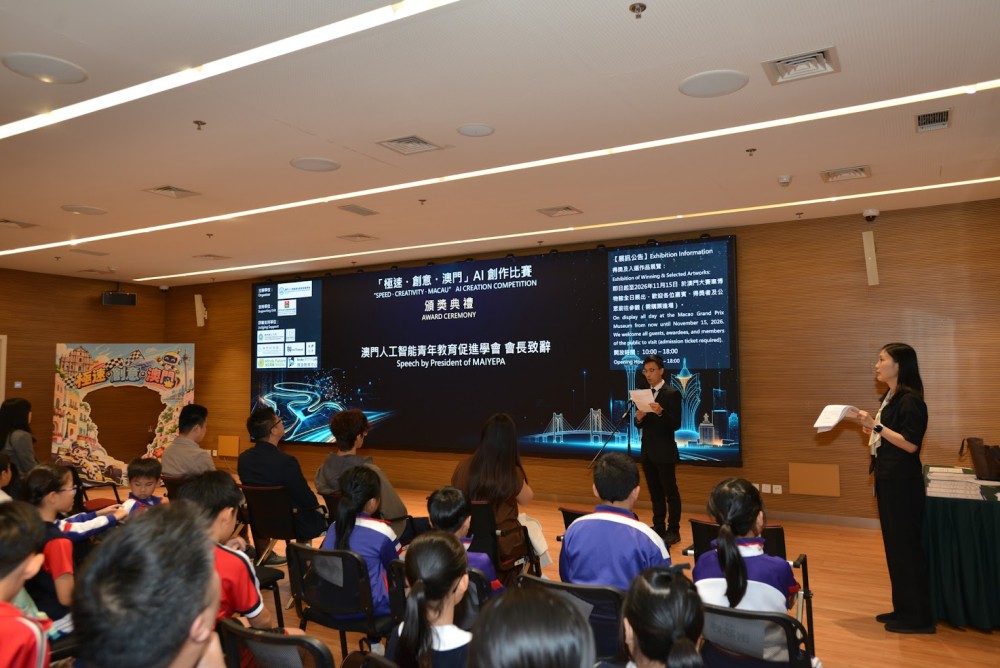
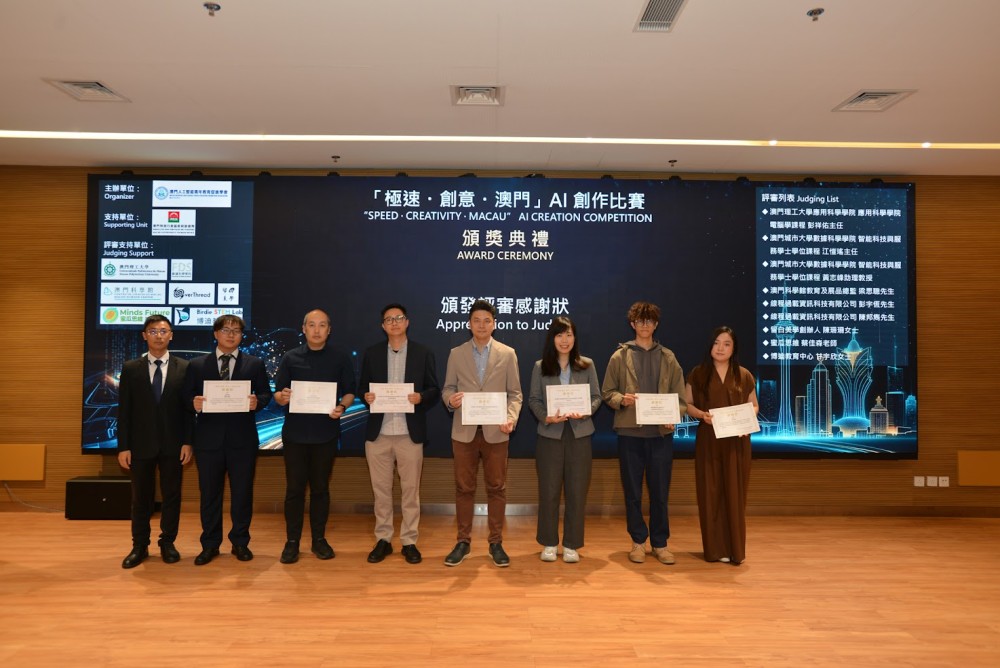
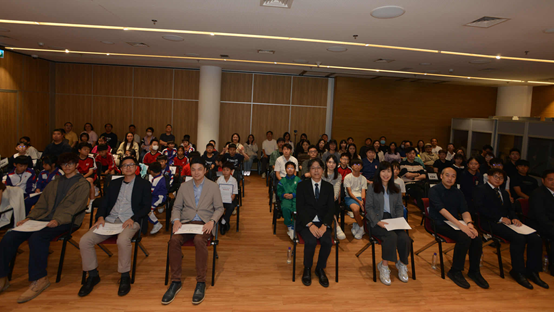
The “Speed · Creativity · Macao” AI Creation Competition, organized by the Macao Youth Association for AI Education Promotion and supported by the Macao SAR Government Tourism Office, has successfully concluded. The awards ceremony was grandly held at 2:30 p.m. on November 14, 2026, at the Macao Grand Prix Museum. Associate Professor Hoi Io Kong and Assistant Professor Chi Fong Wong of the Faculty of Data Science, City University of Macau, were invited to serve as judges of the competition and attended the awards ceremony, joining a group of young creators in witnessing the creative achievements born from the integration of artificial intelligence technology and Macao’s racing culture.
The competition responded to the national “AI Plus” initiative and took Macao’s annual signature event—the Macau Grand Prix—as its core theme. It encouraged students and the general public across Macao to use generative artificial intelligence (AIGC) technologies to interpret the speed and passion of motorsport through AI images, AI short films, and other artistic forms, integrate Macao’s urban landscape and racing culture, and imagine the infinite possibilities of the future racing world, thereby promoting the deep integration of artificial intelligence technology with digital cultural creativity and science popularization education. The choice of the Macao Grand Prix Museum as the venue was particularly meaningful: the museum brings together history, sports, science popularization, technology, and cultural creativity, and has long adhered to the concept of “learning through fun” in promoting the dissemination and inheritance of racing culture, which is highly consistent with the competition’s positioning of “technology empowering culture.” Presenting and honoring AI creations in an authentic racing-culture setting was both an affirmation of the participants’ creativity and an opportunity for the public to directly experience, within the museum’s immersive atmosphere, the expanded possibilities that artificial intelligence technology offers for the expression of local culture.
The “AI Plus” initiative to which the competition responded has a clear policy context in Macao. The Macao Economic and Technological Development Bureau has noted that artificial intelligence is a major opportunity for Macao to break through resource bottlenecks and promote economic diversification. Macao is relying on world-class leisure and tourism settings, its advantages under “One Country, Two Systems” and as a China–Portuguese-speaking countries platform, and long-term capital mobilized by government-guided funds to accelerate its integration into the national “AI Plus” strategy. Against this background, the competition used the Macau Grand Prix—Macao’s most recognizable sports and cultural brand—as its entry point to guide young people and the public in engaging in digital cultural and creative practice through generative AI. In essence, it translated a macro-level policy vision into a participatory and perceptible experience of science popularization and creation, providing a community-level example of the implementation of “AI Plus cultural tourism and exhibitions” through collaboration between academia and society.
The Faculty of Data Science has long been committed to promoting AI science popularization and has actively participated in various local AI innovation competitions and social services in Macao, building a bridge between academia and society. The appointment of Associate Professor Jiang Kaiyao and Assistant Professor Huang Zhifeng as judges was another concrete practice of the Faculty’s teachers continuing to step out of the classroom and serve society. Previously, Associate Professor Jiang Kaiyao had been invited multiple times to visit local secondary school campuses to deliver special science popularization lectures on artificial intelligence, exchanging views with teachers and students on the development history, core principles, application scenarios, and potential risks of AI, and encouraging secondary school students to explore interdisciplinary potential driven by interest. The Faculty’s sustained investment in science popularization and education has accumulated practical experience for teachers and students to participate in the judging and mentoring of public-facing AI competitions of this kind.
Looking at the broader technological landscape, the combination of AI and the racing field is accelerating globally. In top international competitions, generative AI has already been used to help fans design custom tracks, generate race strategies, and customize visual content. Artificial intelligence is extending from the competitive level to the level of participation in and expression of racing culture. By using AIGC as a creative tool and Macao’s racing culture as narrative material, the competition echoed this trend in the local context and provided Macao’s youth with a practice ground for reinterpreting local cultural symbols through the language of technology.
In the future, the Faculty of Data Science will continue to encourage teachers and students to step out of the classroom and participate in industry-academia-research and science popularization practice activities, guide young people to grasp the wave of AI development, use technology to tell Macao’s local stories well, and help develop Macao’s digital cultural and creative industries. The Faculty will also deepen cooperation with local institutions and schools, leverage its disciplinary strengths to empower science popularization education and the cultivation of cultural and creative talent, and inject more youth power from the fields of data science and artificial intelligence into Macao’s “1+4” appropriate economic diversification.
