
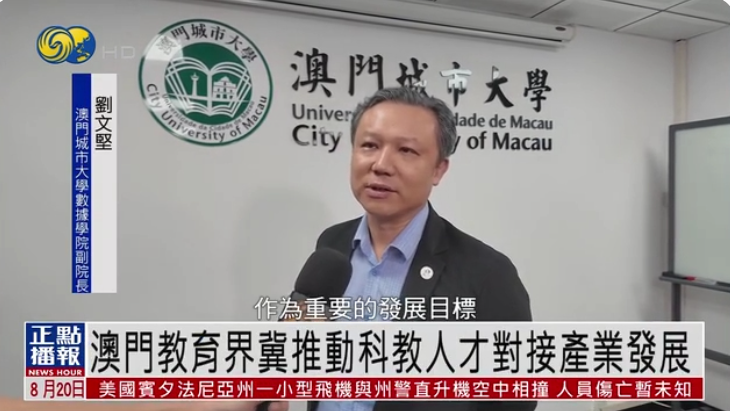
On 21 August 2026, Associate Dean Liu Wen‑jian from the Faculty of Data Science, City University of Macau, was interviewed by Phoenix Television. He shared his insights on topics including the integrated‑development goals for education, science‑technology and talents outlined in Macao’s 3‑5‑Year Plan, the development of the Guangdong‑Macao International Education (University) City, the industry‑university‑research translation of outcomes by higher‑education institutions, and support for Macao’s “1+4” key industries. The interview explored how Macao’s higher‑education sector can break away from past fragmented development, adopt a practice‑oriented approach driven by industrial demands to guide teaching and research, and cultivate sustainable talent momentum for Macao’s appropriate economic diversification.
Associate Dean Liu stated that the 3‑5‑Year Plan takes the integration of education, science‑technology and talents as a core development objective, ending the previous fragmented progress of these sectors. For Macao’s education system, the fundamental implication is to establish a practice‑led framework where industrial needs steer teaching and scientific research. He noted that local universities have produced many high‑quality academic achievements, yet some teaching designs, research topics and talent‑training initiatives operate in relative isolation and are insufficiently aligned with real‑world local‑industry scenarios. This three‑pronged co‑ordination model redirects higher education beyond textbooks and academic papers. It aligns curriculum development, research projects and talent recruitment closely with Macao’s “1+4” key‑industry strategy.
Citing the Faculty of Data Science at City University of Macau as an example, he pointed out the faculty’s disciplinary strengths in smart healthcare and information security. Under the integrated‑development framework for education, science‑technology and talents, the faculty directly responds to practical industrial demands from medical institutions and public‑data‑governance stakeholders in Macao, mainland China and internationally. It embeds real‑world industry cases into curricula and adjusts themes for internships and graduation projects to cultivate technical talents tailored to Guangdong‑Macao development needs. As Guangdong‑Macao co‑operation advances, the faculty will deepen collaboration with medical organisations and data‑security enterprises within the Hengqin Guangdong‑Macao Deep‑D‑Cooperation Zone, opening up channels for teaching‑and‑research‑practice integration. Recruited researchers will undertake both teaching duties and industrial‑project research. While upholding rigorous academic standards, the faculty promotes the real‑world application of research outputs, enabling the university to serve as a genuine talent pool and technology source underpinning Macao’s appropriate economic diversification.
Turning to Guangdong‑Macao integration, Associate Dean Liu argued that long‑term prosperity and stability in Macao depends on leveraging the synergies between Macao and Hengqin. Building the Guangdong‑Macao International Education (University) City can effectively attract people and nurture home‑grown talents. The crux lies in genuinely linking curriculum delivery, research projects and industrial practice, so as to form a closed‑loop talent‑support ecosystem that enables talents of all levels to study, stay, serve and pursue innovation and entrepreneurship in Guangdong‑Macao. This will deliver sustainable, growth‑oriented momentum for Macao’s appropriate economic diversification.
As one of Macao’s leading faculties focused on data science and artificial intelligence, the Faculty of Data Science adopts a disciplinary layout that keeps pace with global academic frontiers whilst addressing practical skill gaps in key sectors such as big‑health services, high‑tech industries and modern finance. The faculty has established a complete bachelor‑master‑doctorate training system for data science and computer science, launched new undergraduate, master’s and doctoral programmes in artificial intelligence, and developed inter‑disciplinary research streams covering cybersecurity, robotics, tourism digitalisation, smart elderly‑care health management and fintech.
In terms of curriculum design, the faculty engages in in‑depth co‑operation with renowned international universities. It prioritises scenario‑based AI teaching, drives teaching and research through project‑based practice, and strengthens industry‑implementation competencies across bachelor, master and doctoral training. Students are enabled to keep abreast of cutting‑edge scholarship and hone vocational skills via joint‑laboratory initiatives and real‑life industrial projects. A gradient‑structured talent pipeline is being built to fill technical‑skill gaps at the front‑line of local industries.
He emphasised that the country does not expect Macao to become a copy of Shenzhen or Hong Kong. Instead, Macao should develop into a sustainable Special Administrative Region that connects two‑way with international markets and mainland China, preserves its unique appeal and fosters self‑sustaining growth. Macao’s “1+4” economic‑diversification strategy should also explore richer development connotations. Higher education must build on Macao’s unique positioning, draw on Guangdong‑Macao co‑operation platforms, and deeply integrate talent cultivation, scientific research and industrial development, so as to translate educational‑and‑technological dividends into long‑term urban‑development competitiveness.
