
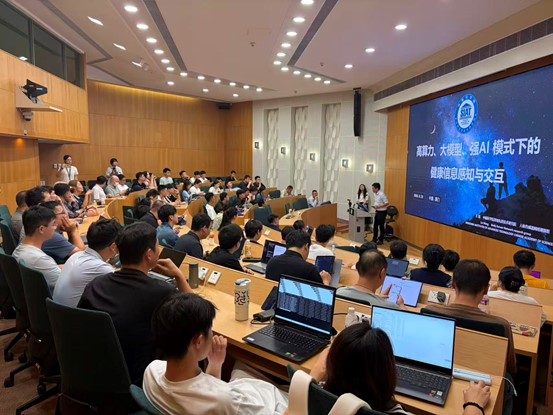
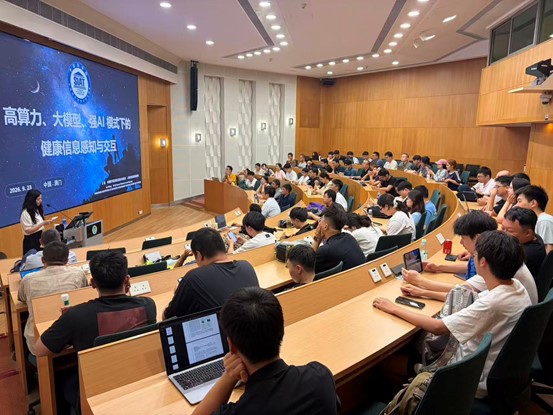
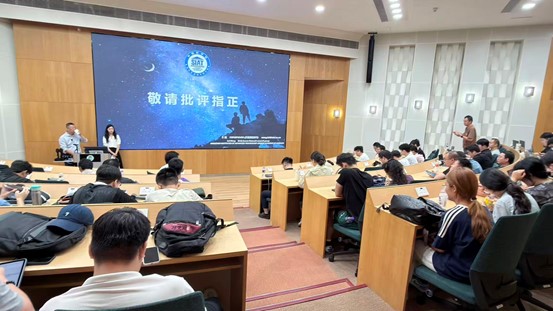
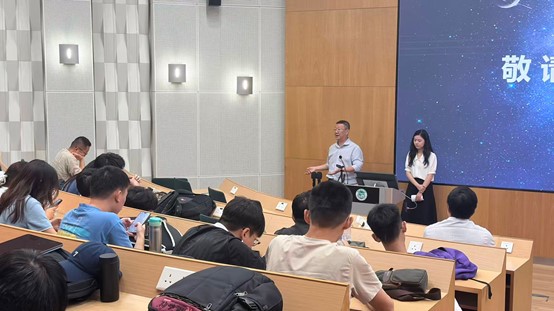
On the afternoon of 23 September 2026, an academic lecture organized by the Faculty of Data Science (FDS) of City University of Macau was successfully held at HG01, Ho Yin Convention Centre, Taipa Campus. Professor Lei Wang of the Shenzhen Institute of Advanced Technology, Chinese Academy of Sciences was invited as the keynote speaker. Under the title "Health Information Perception and Interaction in the Era of High-Performance Computing, Large Models and Strong AI", he shared insights on human body sensing feature engineering, artificial intelligence and digital health.
Professor Wang is a National Leading Talent of the "Ten Thousand Talents Program" in Scientific and Technological Innovation, a Fellow of the Institution of Engineering and Technology (IET), and an IEEE Senior Member. He has long been engaged in research on body sensor networks and multimodal human body sensing features, and has been named on the global top 2% of scientists list jointly released by Stanford University and Elsevier. A number of his research outcomes have been successfully commercialized.
During the lecture, Professor Wang first introduced the research background of sensing feature engineering in medical artificial intelligence. He pointed out that multivariate time series analysis can effectively characterize the nonlinear and higher-order self-organizing properties of human body systems. Against the backdrop of rapid advances in high-performance computing, large models and AI technologies, designing more effective and reliable feature description methods has become an important research direction for enhancing the perception of, and interaction with, health information.
Drawing on his team's research work, Professor Wang then presented a research approach that applies modern engineering mathematics to the analysis of body sensor network data, and shared sensing feature engineering solutions for scenarios such as human motion, mechanical characteristics and EEG states. He also elaborated on the design of digital health and medical technology, as well as the real-world application of related technologies in different scenarios, giving the faculty and students present a more comprehensive understanding of the interdisciplinary research between AI and health information perception.
During the Q&A session, faculty and students actively raised questions, exchanging views with Professor Wang on human body sensing data analysis, the application of AI technologies in digital health, and the practical implementation of related research. Drawing on his research experience, Professor Wang gave detailed answers, and the discussion was lively and engaging.
The academic lecture concluded with warm applause. Through the lecture, faculty and students gained further insights into the latest research progress in sensing feature engineering and AI technologies in health information perception and interaction, and developed a deeper understanding of digital health technologies and their applications.
